Love's Philosophy
Shelley's 'Love's Philosophy' is a masterful blend of Romantic ideals and passionate persuasion, using the unity of the natural world to argue for human connection. It's a highly rewarding poem for the exam because its clear structure and rich natural imagery provide excellent opportunities for AO2 analysis, while its pantheistic undertones offer sophisticated AO3 context points.
Study Notes
Overview
'Love's Philosophy', written by Percy Bysshe Shelley around 1819, is a lyric poem that presents a passionate argument for romantic union. The speaker observes that everything in the natural world is connected and unified by a 'law divine', and uses this observation to persuade his beloved that they, too, should be united. For examiners, this poem is an excellent vehicle for demonstrating AO2 (analysis of methods), particularly in discussing how Shelley constructs a logical argument out of emotional desire. High-scoring candidates will recognise that the poem is not a literal philosophical treatise, but a persuasive, emotionally charged plea rooted in Romantic ideals about nature and emotion (AO3).
Plot/Content Overview
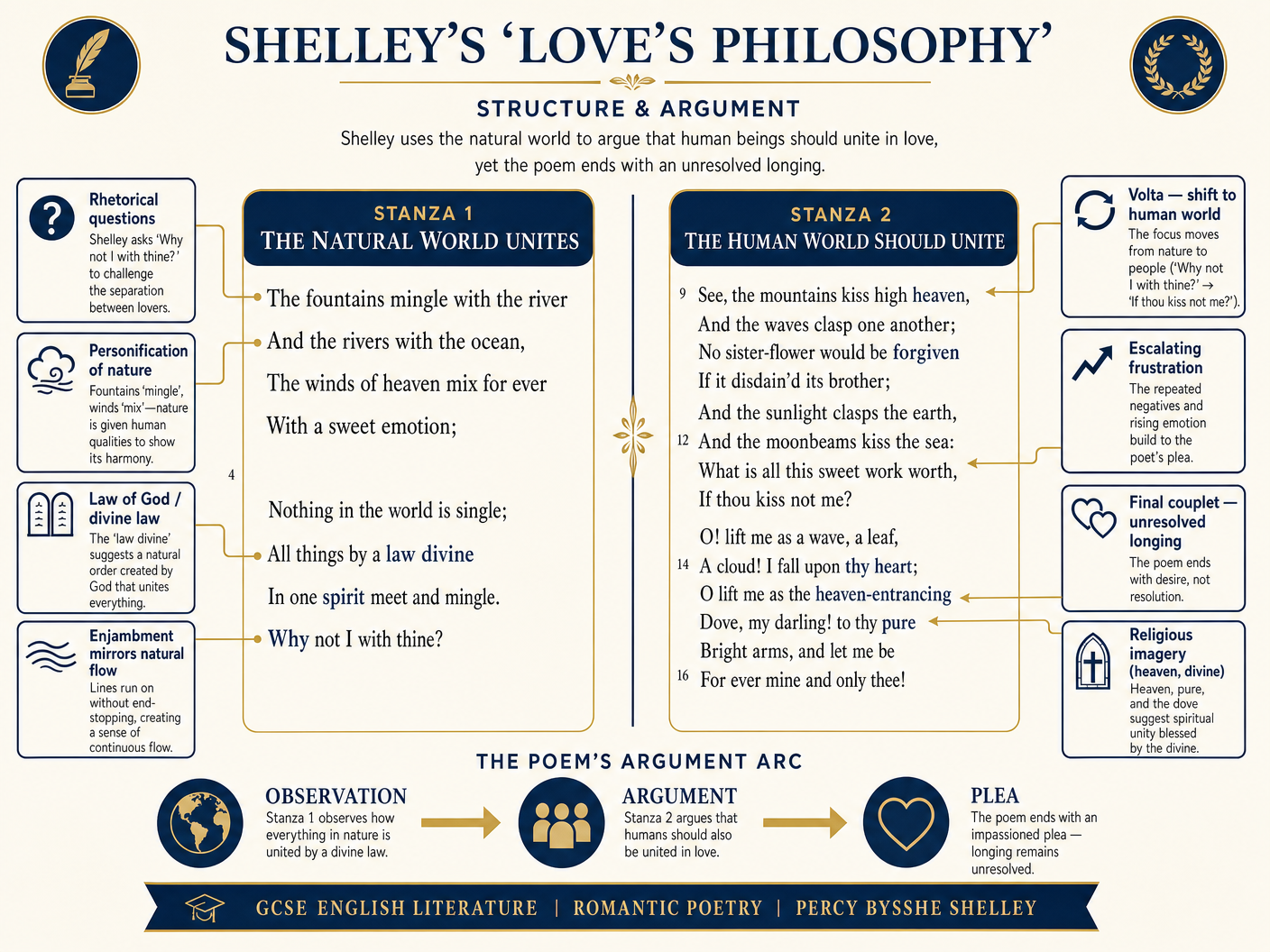
- Stanza 1: The speaker observes the natural world, noting how fountains, rivers, oceans, and winds all mix and mingle. He concludes that nothing in the world is single, as everything is united by a 'law divine', and asks his beloved why they should be any different.
- Stanza 2: The focus shifts to more intimate, physical interactions in nature: mountains kissing heaven, waves clasping, flowers kissing, and sunlight clasping the earth. The poem concludes with a final, unresolved plea: what is the value of all this natural harmony if the beloved will not kiss him?
Themes
Theme 1: Unity and Nature
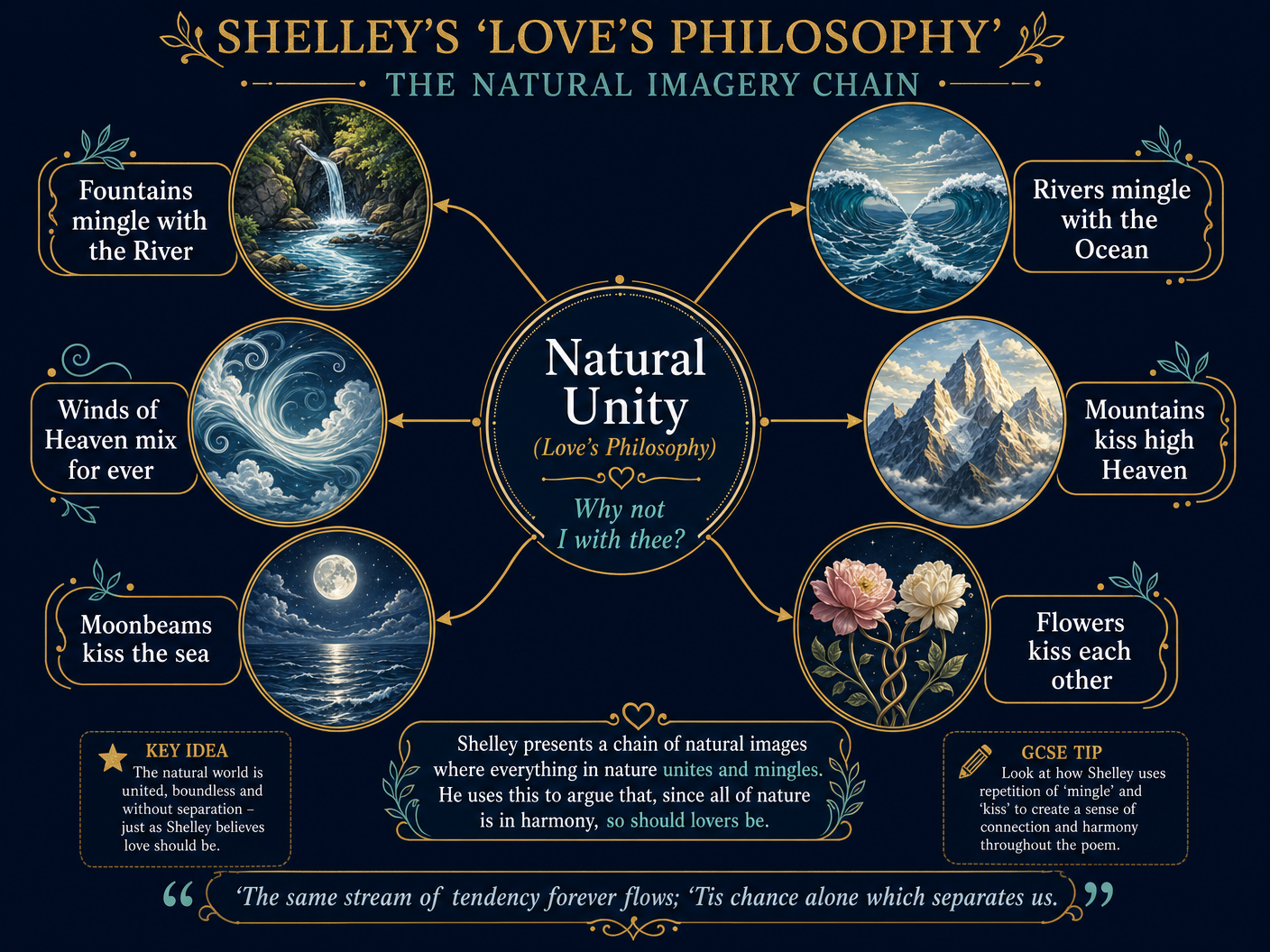
Shelley presents nature not just as a beautiful backdrop, but as an active, unified force. The poem argues that connection is the fundamental law of the universe.
Key Quotes:
- "The fountains mingle with the river" (Stanza 1) - The verb 'mingle' establishes the theme of natural, effortless connection.
- "Nothing in the world is single" (Stanza 1) - A definitive, absolute statement that forms the core of the speaker's 'philosophy'.
Theme 2: Unrequited Love and Longing
Despite the speaker's forceful argument, the poem is fundamentally about unfulfilled desire. The harmonious natural world contrasts with the speaker's isolated state.
Key Quotes:
- "Why not I with thine?" (Stanza 1) - The rhetorical question reveals the speaker's frustration and isolation from the natural order.
- "What is all this sweet work worth, / If thou kiss not me?" (Stanza 2) - The final lines show that without human connection, the beauty of nature is meaningless to the speaker.
Theme 3: Religion and the Divine
Shelley, despite his radical views and atheism, uses religious terminology to elevate his romantic plea, suggesting that their union is ordained by a higher power.
Key Quotes:
- "All things by a law divine" (Stanza 1) - Suggests that their love is not just a personal desire, but a mandate from God or a pantheistic life force.
- "See the mountains kiss high heaven" (Stanza 2) - Blends physical intimacy ('kiss') with spiritual elevation ('heaven').
Writer's Methods
Personification
Shelley extensively personifies nature to make his argument. By giving inanimate objects human actions (mingle, clasp, kiss), he suggests that the desire for union is a universal trait. This makes the beloved's refusal seem unnatural. For example, the "moonbeams kiss the sea" attributes tender, romantic affection to celestial bodies.
Rhetorical Questions
The poem is punctuated by two crucial rhetorical questions at the end of each stanza. These are not genuine inquiries but persuasive devices designed to challenge the beloved. They shift the tone from observant to demanding, highlighting the speaker's frustration.
Structure and Form
Written as a lyric poem, it expresses intense personal emotion. The regular ABABCDCD rhyme scheme and iambic rhythm create a flowing, musical quality that mirrors the harmony of the natural world being described. The use of enjambment further enhances this sense of continuous, unrestrained flow.
Context
Romanticism: As a key figure of the Romantic movement, Shelley believed in the primacy of emotion and the profound power of nature. The Romantics saw nature as a moral guide; thus, if nature is unified, humans should follow its example. This context is vital for AO3.
Pantheism: The idea that God or a divine spirit is present in all things. The reference to a 'law divine' reflects this belief, suggesting a spiritual energy that connects all elements of the universe, elevating the speaker's physical desire to a spiritual imperative.
Visual Resources
2 diagrams and illustrations
Interactive Diagrams
1 interactive diagram to visualise key concepts
Conceptual Flow Outline
The Logical Structure of the Speaker's Argument
Worked Examples
1 detailed example with solutions and examiner commentary
Practice Questions
Test your understanding — click to reveal model answers
Compare how poets present the power of nature in 'Love's Philosophy' and one other poem from your anthology.
Hint: Consider how Shelley uses nature as a persuasive tool for love, and contrast this with a poem where nature is a destructive or awe-inspiring force (e.g., 'Storm on the Island' or 'Extract from The Prelude').
How does Shelley use structure and form to convey the speaker's feelings in 'Love's Philosophy'?
Hint: Focus on the shift (volta) between stanza 1 and 2, the use of enjambment, and the rhetorical questions at the end of the stanzas.